
CASについてAbout CAS
ソテツを枯らすカイガラムシ Aulacaspis yasumatsuiAulacaspis yasumatsui, the scale insect that kills cycads
CASの問題とは
CASとは、ソテツを枯死に至らしめる、東南アジア原産のカイガラムシです。
- 学名
- Aulacaspis yasumatsui
- 英語名
- Cycad Aulacaspis Scale(通称 CAS)
- 和名
- ソテツシロカイガラムシ(時広五朗による仮称)
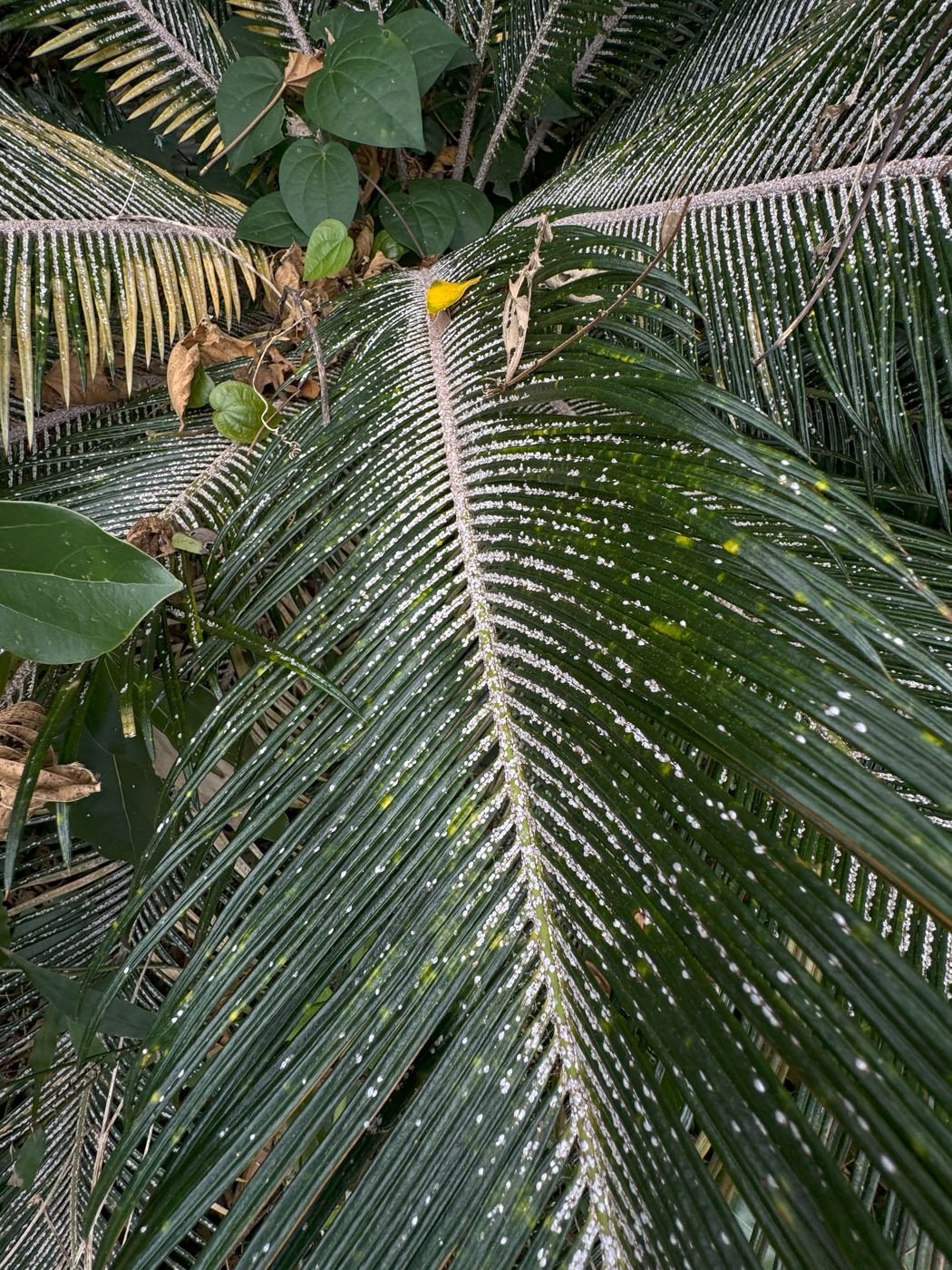
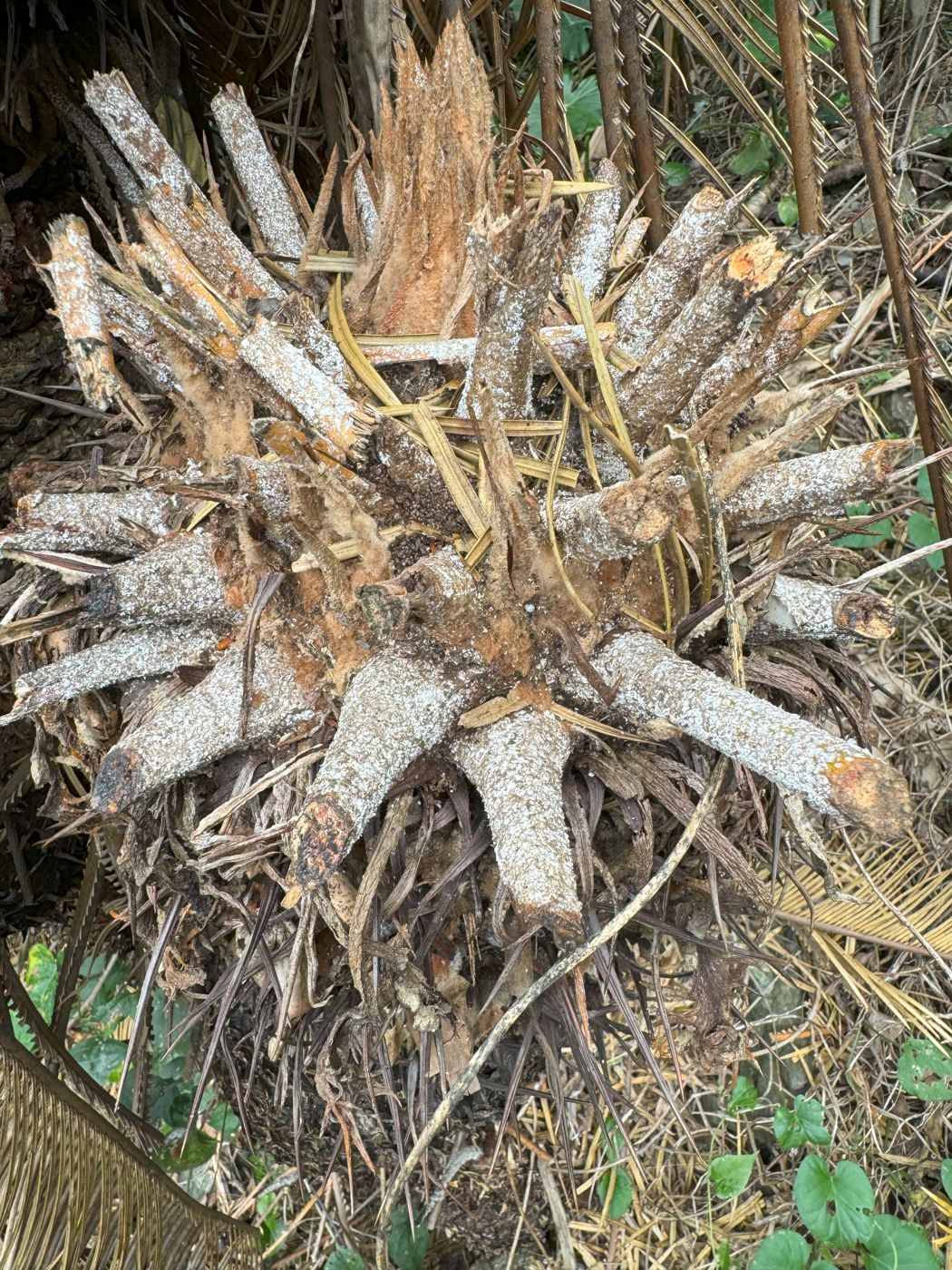
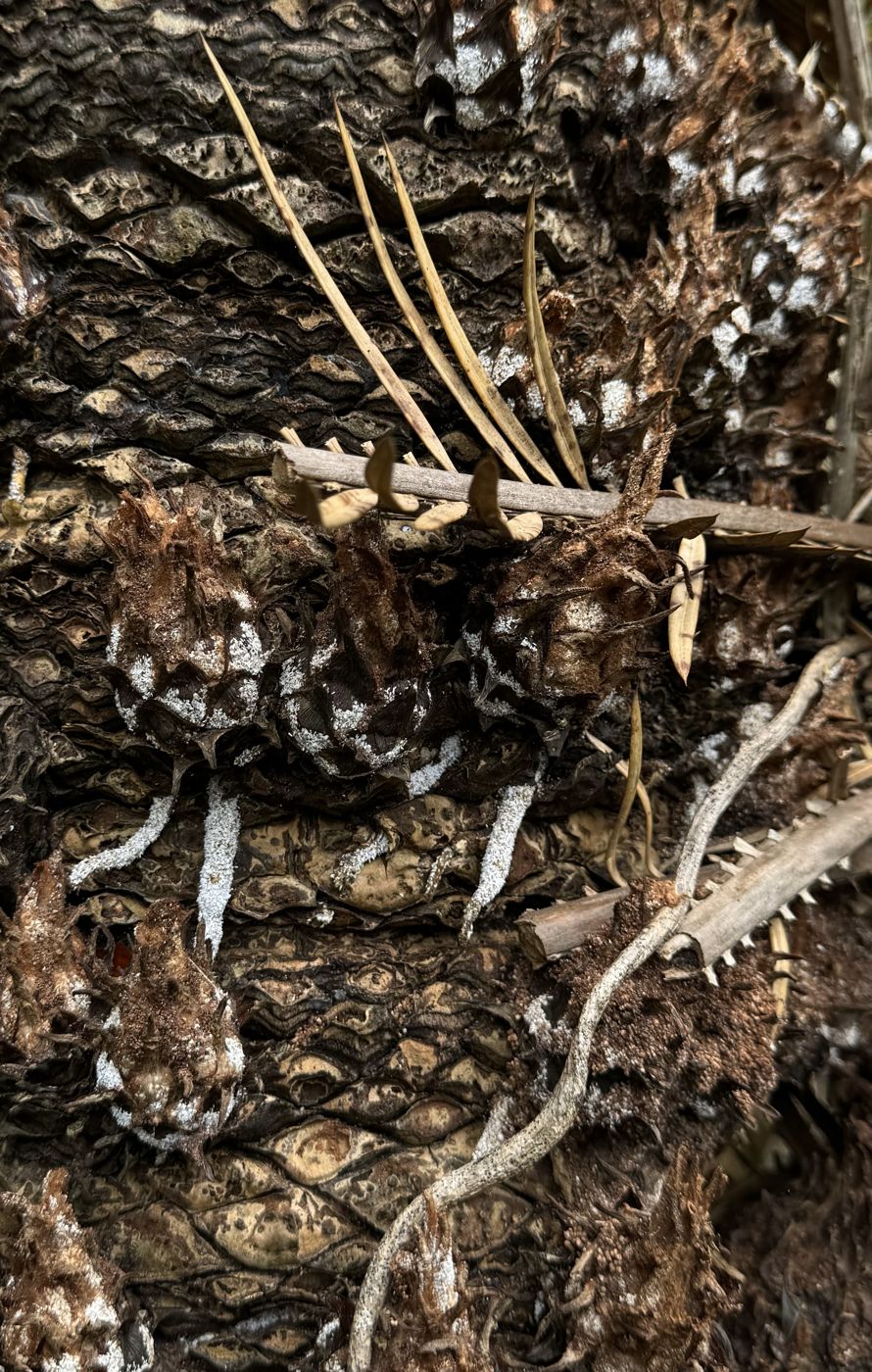
CASが付いたソテツ(左から葉、株の頂部、幹と子株)。奄美大島、2023年12月 撮影:日本ソテツ研究会
1972年にタイで初めて Cycas revoluta 上で発見され、1977年に高木貞夫によって記載されました[1]。その後、ほかの東南アジア諸国でも観察され、ソテツ属(Cycas)の害虫として認識されるようになりました。
1994年にフロリダ州マイアミに持ち込まれたCASは、以後広く蔓延し[2]、1996年にはソテツ属にとって致命的な脅威と認識されていました[3]。フロリダでは、この害虫を防除するための一般的な対策は効果がなく、急速に侵入範囲を広げました[4]。
日本でCASが初めて見つかったのは2005年4月21日で、台湾から門司港に到着した台湾産ソテツ苗木から検出されたことが時広五朗により報告されています(同定は高木貞夫による)。時広はこのとき、警告的なレポートを残しています[5]。
国内での生息が初めて確認されたのは、2021年から2022年にかけてです。奄美大島の山羊島周辺で Cycas revoluta の群生が枯死していることが行政に認知され、鹿児島県森林技術総合センターが調査の結果、枯死の原因であるカイガラムシを2022年11月29日に Aulacaspis yasumatsui と同定し、12月5日に国内での生息の初確認としています[6]。
またそれに先立ち、集団枯死を行政に報告していた内山大輔(奄美市在住)と、現在日本ソテツ研究会会長である高梨裕行(筆者、大阪市在住)が、同年11月20日に記載者である高木貞夫博士に提出したサンプルにより、2022年11月28日に Aulacaspis yasumatsui であることが判明しています。
なお、時広五朗が報告した際のサンプルと、今回の奄美大島での同定に用いられたサンプルのCAS個体は、いずれも形態的に台湾で繁殖している個体の特徴を示しており、台湾から輸入されたソテツにCASが混入していた可能性が高いことが、高木によって示唆されています。
沖縄本島でも、2023年3月に国頭村で生息が確認されています[7]。この記事によると、県は「アウラカスピス―」を含むカイガラムシの防除方法が確立されていると強調したとのことですが、2023年現在、ソテツの伐採を除いてCASの防除方法は確立されていません。
CASの特徴
見た目と見分け方
外見の形態や同定のヒントについては、Amanda Hodges、Greg Hodges らのレポート[8]が詳しいです。
筆者の主観ですが、ほかのカイガラムシと比べると、和名「ソテツシロカイガラムシ」のとおり色は白いものの、外膜(白いほこり)は比較的少なく、ほこりっぽくありません。肉眼では、一般的な園芸害虫であるバラシロカイガラムシ(Aulacaspis rosae)とたいへんよく似ています。アウラカスピス属のほかの種と比べると、頭部が四角く、電球のような外見をしています。
被害が疑われる場合は、まず行政の対策部門へ報告することが必要だと考えます。
寄生と繁殖
- さまざまな種類のソテツの全体、および根に寄生します。根への寄生は、土の深さ60cmに達します。地上部に寄生する個体と根に寄生する個体に、形態の違いはありません[3]。
- 周囲の温度が約24.5℃のとき、卵は8〜12日で孵化します。野外では、16日で2齢、28日で3齢(終齢)に成長した個体もあります。3齢(成熟したメス)は100個を超える卵を産みます[3]。
- マイナス6℃に4時間さらされても死なずに生き残ります[9]。
宿主と原産地
特にソテツ属(Cycas)を好みます。CASは東南アジアで見られるカイガラムシであり、東南アジア原産の Cycas が元の宿主である可能性が示唆されています。CASは主に東南アジアのモンスーン地域で確認されており、熱帯雨林地域のソテツではめったに見られません。CASが根に入り込む能力は、モンスーン地域でよく見られる山火事を生き延びるための適応である可能性が示唆されています[10]。
エンセファラルトス属(Encephalartos)、ザミア属(Zamia)、ディオーン属(Dioon)など、ソテツ属以外のソテツにも被害を及ぼして繁殖しますが、被害が最も大きくなるのは、Cycas revoluta、Cycas taitungensis、Cycas micronesica のような、東南アジア以外に産するソテツ属です。東南アジアの多くのソテツ属の種は、生まれつきある程度の抵抗性を持っていることが示唆されています[11]。CASの原産地には天敵も存在し(複数確認されています)、東南アジアのソテツ自生地でCASの被害が深刻になることはありません。
奄美大島で採取した Aulacaspis yasumatsui の標本プレパラートを、教育・研究に使いたい方は、当会までご連絡いただければ貸し出しが可能です。
世界各地・日本での被害
フロリダ(1994・1995年)
ベトナムや中国で採取された植物に由来し、植物検査官の検査をすり抜けました。害虫の警告や規制が遅すぎたため、蔓延を防ぐことはできませんでした。急速に定着してフロリダ中に広がり、苗木産業に数百万ドルの損害を与えました。感染した Cycas revoluta がフロリダから輸出され、カリブ海の島々などへ広がりました。以降、CASは定着しています。
台湾(2000年)
侵入元は不明ですが、おそらく中国南部の苗床から到達しました。台北の南にある桃園県で、最初の年(2000年)に10万本以上のソテツを枯死させました。2004年に台東蘇鉄自然保護区の野生の個体群に広まり、2005年までにほかの野生個体群へも拡大しました。固有種 Cycas taitungensis の自生地は一掃され、個体数は大きな打撃を受けました。以降、CASは定着しています。
グアム(2003年)
グアム大学の Thomas Marler 博士の再三の警告にもかかわらず、フロリダから持ち込まれた Cycas revoluta に付着して到着しました。2004年9月までに Cycas micronesica の野生の個体群に広まり、2005年までに野生個体群に広く分布しました。固有種 Cycas micronesica の自生地は一掃され、個体数は大きな打撃を受けました。以降、CASは定着しています。
奄美大島(2021年〜)
鹿児島県森林技術総合センターと報道発表によると、2021年からカイガラムシによる被害を確認(未同定)。2022年11月に Aulacaspis yasumatsui と同定されました。2022年12月6日時点で、被害本数は711本(推定)。10月以降、奄美市・龍郷町・大和村で生息が確認されています[6]。
沖縄県(2023年〜)
2023年2月9日に、国頭村でカイガラムシが付いたソテツの葉が変色しているのが確認され、3月9日に農林水産省那覇植物防疫事務所がCASと同定しました。国頭村では3月9日までに43本が被害を受けています[7]。
ほかの国で行われてきた対策や、今も行われている対策の事例(事実関係の整理)については、筆者が『森林技術』2023年3月号にまとめています。
What is the CAS problem?
CAS is a scale insect native to Southeast Asia that kills cycads.
- Scientific name
- Aulacaspis yasumatsui
- English name
- Cycad Aulacaspis Scale (CAS)
- Japanese name
- Sotetsu-shiro-kaigaramushi (provisional name by Goro Tokihiro)
CAS on cycads (left to right: leaves, crown, trunk and offsets). Amami Ōshima, December 2023. Photos: Japan Cycad Society
CAS was first found on Cycas revoluta in Thailand in 1972 and was described by Sadao Takagi in 1977[1]. It was later observed in other Southeast Asian countries and came to be recognized as a pest of the genus Cycas.
Introduced to Miami, Florida in 1994, CAS spread widely[2], and by 1996 it was recognized as a deadly threat to Cycas[3]. In Florida, standard control measures were ineffective and the pest rapidly expanded its range[4].
CAS was first detected in Japan on 21 April 2005, on Taiwanese cycad seedlings that arrived at the port of Moji from Taiwan. This was reported by Goro Tokihiro (identification by Sadao Takagi), who left a report warning of the risk[5].
The first established population in Japan was confirmed in 2021–2022. Local authorities became aware of mass die-offs of Cycas revoluta around Yagi Island on Amami Ōshima. After investigation, the Kagoshima Prefectural Forestry Technology Center identified the scale insect responsible as Aulacaspis yasumatsui on 29 November 2022, and on 5 December announced it as the first confirmed establishment in Japan[6].
Before this, Daisuke Uchiyama (Amami City), who had reported the die-off to the authorities, and Hiroyuki Takanashi (the author, now President of the Japan Cycad Society, Osaka) submitted samples to Dr. Sadao Takagi, who described the species, on 20 November. From these samples, the insect was identified as Aulacaspis yasumatsui on 28 November 2022.
Takagi notes that both the samples reported by Tokihiro and those used for the Amami identification show the morphological features of the population established in Taiwan, suggesting that CAS most likely arrived with cycads imported from Taiwan.
CAS was also confirmed in Kunigami Village on Okinawa Island in March 2023[7]. According to the news report, the prefecture emphasized that control methods for scale insects including Aulacaspis had been established. However, as of 2023, no method of controlling CAS other than cutting down the cycads has been established.
Characteristics of CAS
Appearance and identification
For morphology and tips on identification, see the report by Amanda Hodges, Greg Hodges and colleagues[8].
In the author’s own observation, CAS is white, as its Japanese name (“white cycad scale”) suggests, but compared with other scale insects it has relatively little waxy covering and does not look dusty. To the naked eye it closely resembles the common garden pest rose scale (Aulacaspis rosae). Compared with other Aulacaspis species, its head is square, giving it a light-bulb-like shape.
If you suspect CAS damage, we believe the first step is to report it to the relevant government authorities.
Infestation and reproduction
- It infests the whole plant of many cycad species, including the roots, down to a soil depth of 60 cm. Insects on the roots and on the above-ground parts show no morphological differences[3].
- At about 24.5 °C, eggs hatch in 8–12 days. In the field, some individuals reached the second instar in 16 days and the third (final) instar in 28 days. Third-instar (mature) females lay more than 100 eggs[3].
- It survives four hours at −6 °C[9].
Hosts and origin
CAS particularly favors the genus Cycas. As it is found in Southeast Asia, Southeast Asian Cycas are thought to be its original hosts. It is mainly found in the monsoon regions of Southeast Asia and is rarely seen on cycads in rainforest areas. Its ability to invade roots may be an adaptation for surviving the wildfires common in these monsoon regions[10].
CAS also damages and breeds on cycads outside Cycas, such as Encephalartos, Zamia and Dioon, but the worst damage occurs on Cycas from outside Southeast Asia, such as Cycas revoluta, Cycas taitungensis and Cycas micronesica. Many Southeast Asian Cycas species appear to have some natural resistance[11]. In its native range CAS also has natural enemies (several have been identified), and it does not become severe in Southeast Asian Cycas habitats.
Slide-mounted specimens of Aulacaspis yasumatsui collected on Amami Ōshima are available on loan for education and research. Please contact us.
Damage around the world and in Japan
Florida (1994–1995)
Arrived with plants collected in Vietnam and China and was not caught by plant inspectors. Pest alerts and regulations came too late to stop it. It established quickly and spread throughout Florida, causing millions of dollars in losses to the nursery industry. Infested Cycas revoluta exported from Florida carried it to Caribbean islands and elsewhere. CAS has been established ever since.
Taiwan (2000)
Origin unknown, probably from nurseries in southern China. In Taoyuan County, south of Taipei, it killed more than 100,000 cycads in the first year (2000). In 2004 it spread to wild populations in the Taitung Cycad Nature Reserve, and by 2005 to other wild populations. Habitats of the endemic Cycas taitungensis were wiped out and the population was severely damaged. CAS has been established ever since.
Guam (2003)
Despite repeated warnings from Dr. Thomas Marler of the University of Guam, CAS arrived on Cycas revoluta plants from Florida. By September 2004 it had spread to wild populations of Cycas micronesica, and by 2005 it was widespread in the wild. Habitats of the endemic Cycas micronesica were wiped out and the population was severely damaged. CAS has been established ever since.
Amami Ōshima (2021–)
According to the Kagoshima Prefectural Forestry Technology Center and press releases, scale insect damage was observed from 2021 (unidentified at the time) and identified as Aulacaspis yasumatsui in November 2022. As of 6 December 2022, an estimated 711 plants were affected. Since October, it has been confirmed in Amami City, Tatsugō Town and Yamato Village[6].
Okinawa (2023–)
On 9 February 2023, discolored cycad leaves with scale insects were found in Kunigami Village, and on 9 March the Naha Plant Protection Station of the Ministry of Agriculture, Forestry and Fisheries identified them as CAS. By 9 March, 43 plants in Kunigami had been affected[7].
The author has summarized the control measures taken in other countries, past and present, in the March 2023 issue of the Japanese journal Shinrin Gijutsu (Forest Technology).
参考文献References
- Takagi, S. A new species of Aulacaspis associated with a cycad in Thailand (Homoptera: Coccoidea). Insecta Matsumurana New Series 11: 63–72 (1977).
- IUCN/SSC Cycad Specialist Group – Subgroup on Invasive Pests. Report and Recommendations on Cycad Aulacaspis Scale, Aulacaspis yasumatsui Takagi (Hemiptera: Diaspididae).
https://www.fs.usda.gov/Internet/FSE_DOCUMENTS/stelprdb5437896.pdf - Forrest W. Howard, Avas Hamon, Michael McLaughlin, Thomas Weissling and Si-lin Yang. Aulacaspis yasumatsui (Hemiptera: Sternorrhyncha: Diaspididae), a Scale Insect Pest of Cycads Recently Introduced into Florida.
https://www.jstor.org/stable/3495833 - T. J. Weissling, F. W. Howard and A. B. Hamon. Cycad Aulacaspis Scale, Aulacaspis yasumatsui Takagi (Insecta: Hemiptera: Sternorrhyncha: Diaspididae).
https://edis.ifas.ufl.edu/publication/IN253 - 時広五朗(Goro Tokihiro). 台湾産ソテツ苗木から発見されたソテツシロカイガラムシ(仮称)について.
https://jglobal.jst.go.jp/detail?JGLOBAL_ID=200902259494193456 - 鹿児島県 森づくり推進課 森林技術総合センター. ソテツを加害するカイガラムシ Aulacaspis yasumatsui の国内初確認について(報告).
http://www.kpftc-pref-kagoshima.jp/kadai/Aulacaspis_Yasumatsui.pdf - 琉球新報(Ryukyu Shimpo)2023年3月21日. ソテツを枯らす外来種の害虫、沖縄で初確認 国内で2例目 すでに防除も県が注意呼びかけ.
https://ryukyushimpo.jp/news/entry-1680818.html - Amanda Hodges, Greg Hodges. Field and Taxonomic Identification of Cycad Aulacaspis Scale.
https://ipmsymposium.org/2006/sessions/39-2.pdf - Edwin R. Duke and Alfredo B. Lorenzo. Survival of the Cycad Aulacaspis Scale in Northern Florida during Sub-Freezing Weather.
https://journals.flvc.org/fshs/article/download/86577/83493/0 - F. W. Howard. Aulacaspis yasumatsui (cycad aulacaspis scale). CABI Compendium.
https://www.cabidigitallibrary.org/doi/10.1079/cabicompendium.18756 - William Tang, Chip Jones, Anders Lindström, Art Vogel. Cycad Cultivation and Landscaping.
https://www.cycadgroup.org/?page_id=603